[Who Benefits?] What's Strange About Clubs and Festivals in Japan's Galápagos Scene [Music Never Becomes the Main Course]
I currently live in Southeast Asia and have also visited Europe and America, but frankly, there is something constrained about the atmosphere among Japanese people.
The same can apply at club events and festivals.
Bound by strange rules, or exclusionary...
So this time, I'd like to discuss the strange habits you encounter at Japanese club events and festivals “with plenty of my own opinions” and “sometimes without mincing words”.
1: Requiring People to Study Foreign DJs' Tracks Beforehand
 The very sound of the word “preparation” feels rather stiff to me.
I think it's perfectly fine to encounter music for the first time live and appreciate it neutrally.
For example, when enjoying an expensive dinner, rather than researching the ingredients, order of courses or the chef's biography, one of the greatest pleasures is simply putting your faith in the moment the food enters your mouth.
So social media announcements by local DJs helping draw crowds for foreign DJs that say “Please study up beforehand...!” feel very strange to me, haha.
Still, people who do study up beforehand are full of love for music in my view.
2: Deciding Whether to Go Based on the Guest List
 Of course, saving even a little money is welcome, but that itself doesn't determine the content.
To use food as an analogy again, it's like saying, “I won't go because I don't have a coupon!”
Rather, events where you aren't on a guest list may offer more new discoveries.
Including the price, events that are a little harder to attend often turn out to be more interesting.
3: Local DJs' Social Media Announcements Saying “Everyone, Gather!”
 First, a premise: local DJs playing at club events have the major responsibility of attracting customers.
They explore all kinds of ways to attract people, but for various reasons, most methods resemble sales in network marketing.
Because the approach is network marketing, the atmosphere becomes insular.
“Gather” means “Let's all get together and have a good time! It'll be fun!” If you're in that circle, it certainly will be fun.
But for a customer who has no connection to the local DJs and comes for the main foreign act, for example, it can be no fun at all.
Such customers may eventually join the circle somehow (=becoming regulars on the lists of local DJs supporting ticket sales), but either way, the whole event remains inward-looking.
To put it bluntly, it's a “village society.” It feels rather characteristic of island-nation Japan.
4: Checking Each Other with “Do You Know Someone Here?”
 As people become regulars on the lists of local DJs supporting ticket sales, connections between customers can develop.
At those times, you often hear conversations like “I know so-and-so...” It's as though they're being wary of each other and sizing each other up.
A similar case is “...Is so-and-so [an acquaintance or regular] here today?” It's like being in a school class.
Frankly, at club events and festivals, the word “acquaintance” irritates me.
That should be enough. Why do we need evidence of whether we know someone?
Incidentally, when I went to Laurent Garnier's Japan event at Contact Tokyo, I went alone and knew nobody, but made four Western friends.
Open Westerners and closed Japanese people.
I feel those things are part of the unbridgeable gap with Western dance music scenes.
5: Customers Who Only Go to Flashy Pickup Clubs and Trendy Festivals (Party People)
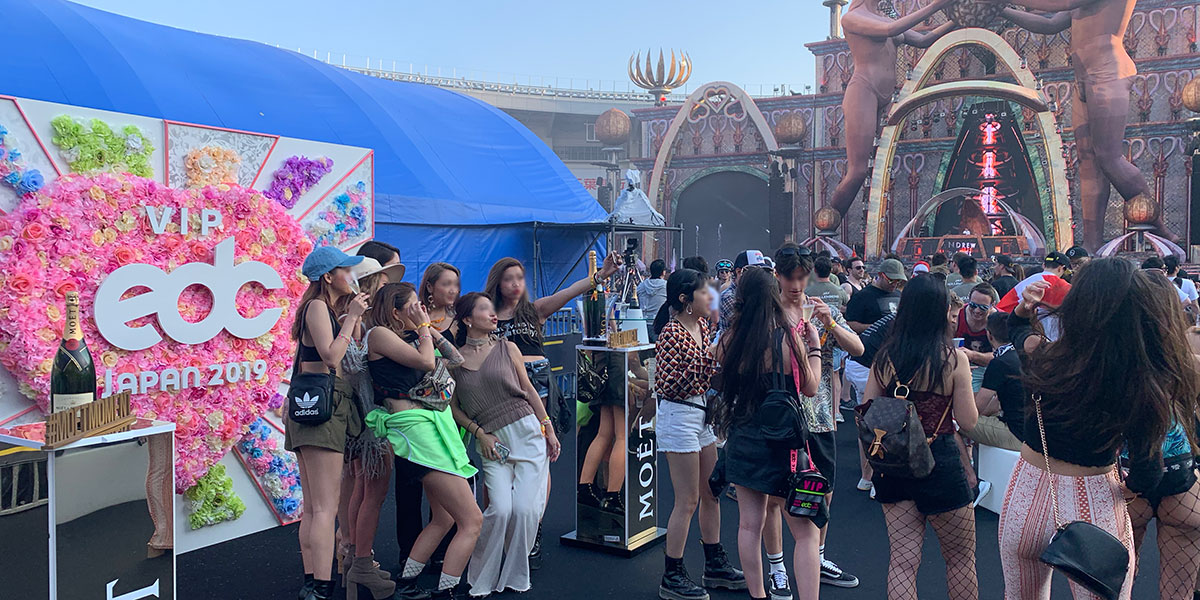 This is the exact opposite of the “village society” pattern.
Flashy pickup clubs (mainly around Roppongi, with free admission for women and fully private VIP rooms equipped with karaoke), and trendy festivals (EDC JAPAN, Ultra Japan) are the only places you see these people.
Of course, this type exists abroad too, but it's especially pronounced in Japan.The “village society (=music events)” is somewhere they will absolutely never come, haha.
And people who proclaim “I love clubs! I love festivals!” are overwhelmingly more common in this group.
Looking at EDC JAPAN and Ultra Japan, you can see there are at least tens of thousands of them.
But with clubs and festivals not yet socially accepted, from the perspective of the Japanese majority, the frustrating thing is that self-proclaimed “club and festival lovers who aren't particularly interested in the music itself” appear to be the mainstream.
So as someone from the music-event world, people unconnected to clubs and festivals have asked me “Are you a party person?”, “Are you someone who drinks and gets violent?” and “Do you go to Shibuya for Halloween?”—ridiculous questions like those, haha.
Well, people who ask such ridiculous questions reveal their own level too.
Conclusion
There are other things, but I'll leave it here this time.
Those who have read this far or attended music events will probably realize that
Unfortunately, in Japan, people who have been familiar with authentic dance music since childhood are a minority, and the environment makes it hard to come to love it after getting somewhat older.
I too lived in that village society. Although, rudely enough, I sometimes thought its village-like nature was creepy, I concluded, “There just aren't that many people who really love dance music itself, so perhaps it's inevitable that this kind of atmosphere emerges.”
Related articles

[Shibuya Contact Tokyo] What's Strange About Clubs in Japan's Galápagos Scene [Keep Gropers Away]
[Tragedy] Reflecting on a Psytrance Artist's Death: Musicians and Events in the 2020s [Sustainability]
[Everything Gets Labeled Partying] Japan's True Dance Music Fans Are Becoming ‘Hidden Christians’ [Prejudice from the Poorly Informed]